AI Is Changing How Small Businesses Work. Is Your Business Ready for the Security Risks?
Artificial intelligence is quickly becoming part of everyday business. Whether it's drafting emails, summarizing meetings, creating marketing content, or helping employees work through a problem, AI tools are making their way into offices of all sizes.
For small businesses, the appeal is easy to understand. When you're working with a small team, anything that saves time can make a real difference.
But there's another side to the conversation that doesn't always get enough attention: What happens to your business information when employees start using AI?
It's a question worth asking, especially when the information involved belongs to your customers, employees, or business partners.
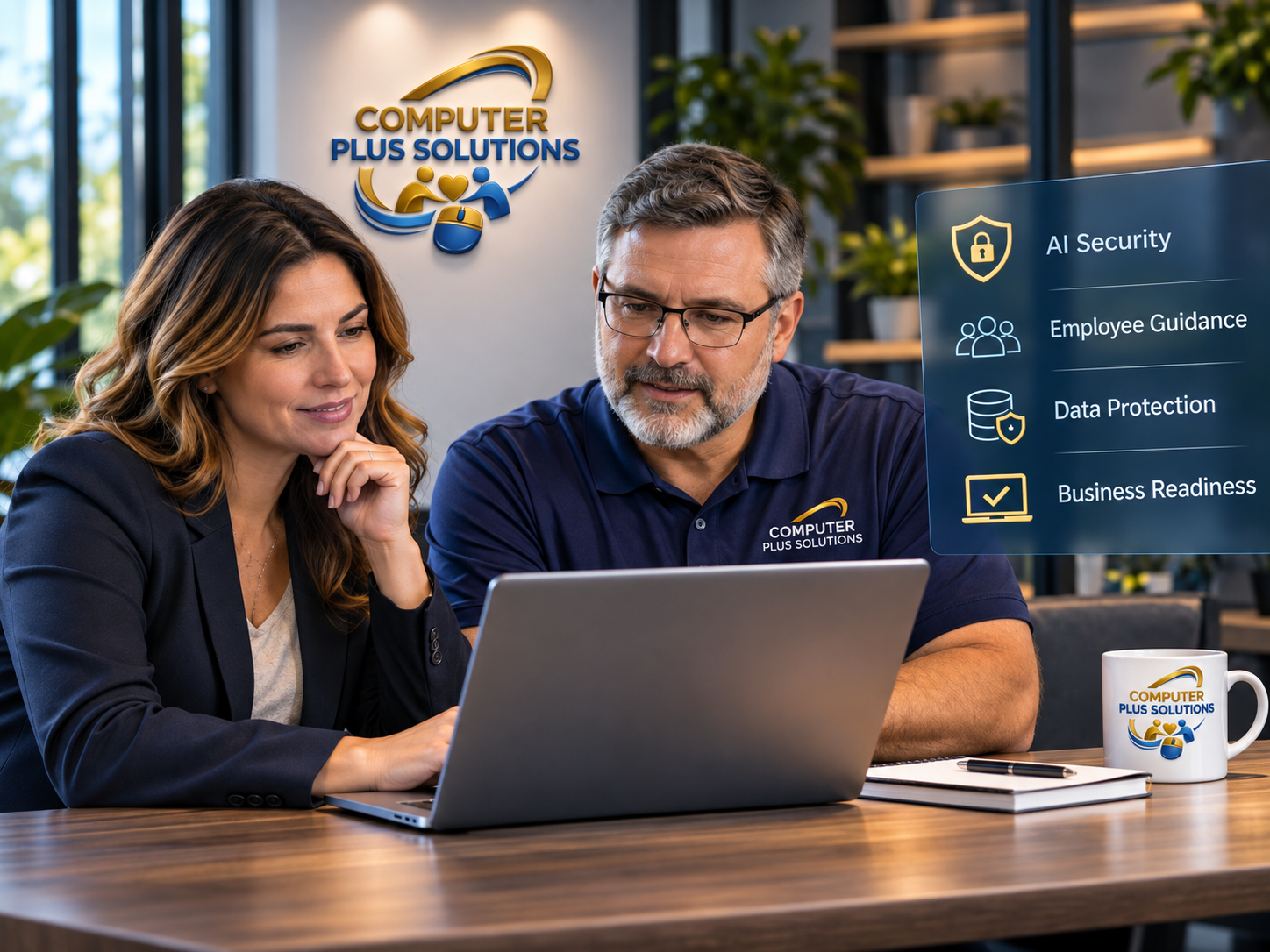
At Computer Plus Solutions, we believe AI can be a valuable tool for small businesses. The key is making sure convenience doesn't come at the expense of security.
Your Employees May Already Be Using AI
You might be surprised by how many AI tools have already found their way into your business.
An employee uses ChatGPT to improve an email. Someone in accounting uploads a spreadsheet to get help with a formula. Your marketing team uses an AI tool to create social media content. Another employee asks an AI assistant to summarize a customer document.
None of these activities necessarily seems risky.
In fact, most employees are simply trying to get their work done faster.
The concern is what they might be sharing along the way.
A spreadsheet could contain financial information. A customer document might include confidential details. Even an innocent-looking email could contain information your business has a responsibility to protect.
Depending on the AI service, its configuration, and your agreement with the provider, information entered into these tools may be stored or processed outside the systems your company normally controls.
That doesn't mean employees should stop using AI. It means business owners need to understand which tools are being used and what information is going into them.
Start With a Conversation, Not Another Complicated Policy
Small businesses don't need to approach AI security the same way a large corporation would.
A good starting point is simply asking your employees how they're using AI.
Which tools do they use? What tasks are they using them for? Are they accessing company documents or customer information?
You may discover useful applications worth encouraging. You may also find a few practices that need to change.
Once you understand what's happening, establish some straightforward expectations.
For example, employees should know which AI tools are approved for business use. They should also understand that passwords, customer financial details, private employee records, and other sensitive information shouldn't be entered into unapproved services.
Make sure someone is responsible for approving new AI applications before employees connect them to company accounts.
These rules don't have to be complicated. They just need to be clear enough that employees can make good decisions without constantly guessing.
Pay Attention to What AI Tools Can Access
One of the biggest concerns with business AI isn't always the information someone manually enters.
It's the information an AI application can access after being connected to another system.
Many AI services integrate with business email, cloud storage, calendars, and collaboration platforms. Those connections can be useful, but they also deserve a closer look.
Imagine an employee connecting an unfamiliar AI application to their Microsoft 365 account. Depending on the permissions granted, that application could gain access to more information than the employee intended.
That's why it's important to review connected applications and their permissions.
At a minimum, businesses should use multifactor authentication, limit access based on employee responsibilities, and remove accounts or integrations that are no longer needed.
If your company uses Microsoft 365, it's also worth reviewing how documents are shared and who can access sensitive files.
AI may be a new part of your technology environment, but protecting the accounts and systems behind it still comes down to good cybersecurity practices.
AI Is Making Scams More Convincing
Not every AI-related security risk comes from the tools your employees use.
Cybercriminals are also taking advantage of AI.
In the past, a poorly written email might have been an obvious warning sign. Today, fraudulent messages can be polished, professional, and surprisingly believable.
AI can also make it easier to impersonate a familiar voice or create convincing messages that appear to come from a manager, vendor, or business partner.
Imagine receiving a phone call that sounds like someone you know, asking you to urgently send money or share account information.
Would your employees know how to verify the request?
This is where a simple business procedure can make all the difference.
If someone requests a change to payment information, verify it through a phone number you already trust. If an employee receives an unusual financial request, require a second person to approve it.
And if a message seems urgent or out of character, there's nothing wrong with making a phone call to confirm it.
Good security isn't always about buying another product. Sometimes it's about making sure people know what to do when something doesn't feel right.
Remember That AI Can Be Wrong
There's another risk that often gets overlooked: trusting AI-generated information too much.
AI tools can produce convincing answers that aren't always accurate.
That matters when employees rely on those answers for financial information, customer communications, technical troubleshooting, or important business decisions.
For example, an AI assistant might suggest a technical fix that sounds reasonable but isn't appropriate for your environment. It could generate a customer-facing statement containing incorrect information or summarize a document while leaving out an important detail.
The solution isn't to avoid AI altogether.
It's to treat AI as a helpful assistant rather than a replacement for experience and judgment.
Encourage employees to verify important information, especially when mistakes could affect customers, finances, or business operations.
AI can help people work more efficiently. Someone still needs to be accountable for the final result.
You Don't Need a Big Budget to Get Started
One of the biggest misconceptions about cybersecurity is that small businesses need expensive systems or a dedicated IT department to protect themselves.
In reality, many of the most useful steps are things your business can start doing today.
Take an inventory of the AI tools employees are using. Make sure business accounts have multifactor authentication enabled. Review access to confidential documents and cloud applications.
Talk with your employees about how to recognize suspicious requests, especially those involving payments, account credentials, or sensitive information.
Check that your business has reliable backups and a plan for responding if information is accidentally exposed.
And don't overlook the basics: keeping computers updated, managing user accounts, and protecting devices remain important, regardless of how much AI your business uses.
You don't have to address everything at once. Start with the risks most relevant to your business and build from there.
A Practical Way to Approach AI Security
If you're not sure where your business stands, consider these four questions:
1. Do we know which AI tools our employees are using?
You can't manage risks you don't know about.
2. Have we established rules for sharing business information with AI?
Employees should understand what information is appropriate to use and what must remain confidential.
3. Are our accounts and company data properly protected?
Multifactor authentication, appropriate access controls, and regular reviews can make a significant difference.
4. Would our employees recognize an AI-powered scam?
Security awareness and simple verification procedures help prevent a convincing message or phone call from turning into an expensive mistake.
If you can't confidently answer these questions, that's a useful place to begin.
Making AI Work for Your Business—Safely
AI isn't going away, and small businesses shouldn't have to miss out on the opportunities it creates.
Used thoughtfully, AI can help employees save time, improve communication, and focus on the work that matters most.
But like any technology you introduce into your business, it should be supported by clear expectations and reasonable security safeguards.
You don't need to become an AI expert to make responsible decisions. You just need to understand the risks, ask the right questions, and make sure your technology is working for your business—not creating problems you didn't expect.
Let's Talk About Your Business Technology
At Computer Plus Solutions, we work with small businesses that want dependable technology without unnecessary complexity.
Whether you're exploring AI tools, reviewing your Microsoft 365 security, or looking for ways to better protect customer information, we can help you understand your options and identify practical next steps.
Because good technology should make running your business easier—and give you confidence that you're protecting Talk to our team: https://computerplussolutions.com/contact/#form